Wednesday, May 15, 2013

Varia: BFA Exhibition - Part 2

The other part of the Boise State University Varia: BFA Exhibition was held in the Hemingway Center on campus.  This venue seems a little more intimate as it is a little darker and free standing walls create different, smaller spaces.

The first two photos show some cyanotype pieces created by Heather Wade.  The first is made on a large piece of cloth. The other is on a small piece on paper.  Heather happened to be there taking pictures and Mary and I discussed her work with her.

Mary works with cyanotype and other alt-processes so Heather was happy to meet someone working in the same medium.


I was attracted to the simplicity, repetition and subject matter of this artwork by Tanith Brown.  The smaller frame has burnt matches attached to the paper.  In the larger frame, the artist has drawn the matches with pencil.


Here is a close up view of the drawing.


I approached this ceramic piece by Elyse Hestead-Murphy from the backside and didn't realize there was a figure until I walked around to the front.  It is made of separate pieces that appeared to be stacked and adhered together.


It seemed like the majority of the artwork in the Liberal Arts building was created by guys, whereas the majority (if not all) of artwork in the Hemingway Center was created by girls.  I don't think this separation was made on purpose, but it's an interesting observation.

Overall, I found the exhibition very interesting.

Tuesday, May 14, 2013

Varia: BFA Exhibition - Part 1

One of the people in our monotype workshop was a BSU student, Karl LeClair.  He told us he had some of his artwork in the Boise State University's BFA Exhibition entitled Varia.  Mary Donato and I said we would go see it.  The last day of the exhibit was last Thursday and that is when we went.

BSU has several gallery spaces spread around campus.  Varia was in two different areas, the gallery in the Liberal Arts building and in the Hemingway Center.  We started in the Liberal Arts gallery.


Overview of the Liberal Arts building gallery.
Below is Karl's piece.  We recognized it right away because 1) it is facing the entry to the gallery and 2) he used a similar motif for his prints in the workshop.  These are all prints and the plates he used to print them are on the floor.


Here is a close up view of some of the prints which were held together by magnets.

Each artist had a statement about their work which was in a binder by the entrance to the gallery. It was very interesting to read the statements.

For example, this blurry picture is of photographs by Stephanie North, entitle As One.  She is exploring the perception of college athletes.  Each photo has a student athlete dressed in their sport's attire and also a photo of them dressed in their street clothes, illustrating the fact that their sport or people's perception of a student athlete is not the only thing that defines the person.


These next two pieces are by Adam Atkinson.  I was surprised to see work using fabric and stitches although I do believe textile/fabric/fiber art is becoming more widely accepted as a fine art (as opposed to fine craft) in the general art world.

I was particularly interested in these because it was a male artist that created them.  The majority of artists working in textile/fabric/fiber tend to be female.  And Atkinson talks about the tradition of hand crafts done by women in his statement and is exploring gender roles in these pieces.

This first piece, Alternate Identity, is reminiscent of Nick Cave's full sized bears covered with found sweaters in the Boise Art Museum's recent exhibition, Meet Me at the Center of the Earth. Perhaps Atkinson was influenced by that.


In this artwork, Looking, Atkinson created lines using hand stitches on canvas.

Toward the middle of the gallery, there was some smaller sculptural work by Everett Hoffman. This one is entitled Our Love of Spoons.  These are very well done with the carving and execution.  Hoffman has taken an everyday object we can all relate to and has put it on a pedestal, literally.


Most of the artwork in this gallery seems to explore perceptions of identity, our roles in society and relationships, all natural subjects for young adults.

In the next post, part 2 of Varia.

Sunday, May 12, 2013

Drawing at Surel's Place

Did I mention that I am an art-workshopolic?  On Saturday, I attended a drawing workshop at Surel's Place in Garden City.  It was free, so how could I resist?

For those who do not know, Surel Mitchell was a local artist.  Unfortunately, I did not know her personally, but knew of her.  After she passed away, her house was donated to the city and is now used  for an artist-in-residence.


I like how the artwork and books owned by Surel are still there.  Here is a small, blurry picture of the tiny bathroom that has artwork covering almost every inch of the walls.  These were by different artists.


The current artist-in-residence is Jennifer Wu and she was the workshop instructor.  What we did was look at artworks by some of the masters and drew them.  I liked what Jennifer said at the beginning, that it doesn't matter if we end up with something looking like the painting, the point is to see what the artist did. And we did not share our drawings, although you could see what others were doing.

Also, we were asked to point out things we noticed about the painting as we were sketching.  It really is a good exercise as you are looking at a piece for an extended period of time and noticing things you wouldn't if you only spent five minutes looking.  It also makes you appreciate the artwork more.

We spent about a half an hour on each drawing looking at a projected image on a screen.  All the artworks were paintings, so translating it into a drawing was a little different.  We were asked to bring our own drawing supplies.  So, I brought my sketchbook, some larger paper and an assortment of pens and pencils.

While she was in town, our printmaking instructor, Rose Davies (from Wales), gave a little talk about her daily sketching habit. She uses pens for her sketching and at one point said that pencils were for wussies (jokingly, I think).  But at another time when she was talking about teaching rehab patients to draw, she said she never gives them pencils because it is too advanced for them.  So, I'm not sure where she really stands on the issue, except that she uses a pen.

I admit I am a wuss and like to use pencil in case I would like to erase.  I understand that the point of the pen is to commit to the line and not worry about mistakes, I guess.

Anyway, I used my mechanical pencil and drew in my regular sketchbook.  I did not have my eraser out and, hence, did not use one.

Here is my first drawing.  We were looking at Picasso's A Muse.  I scanned all these drawings in black and white so the contrast is not really as much as it seems here.


Since I started the drawing on the left hand side of the paper, I ran out of room when I got to the second figure on the right.  You can see a couple of mistakes where I was not able to erase.

For the second drawing, we looked at a still life by Cezanne.  This artwork had a lot of dark values and was very painterly, which made it hard to translate into a drawing.


The third artwork was Bonnard's Dining Room in the Country.


By the last drawing, I was getting tired of drawing the masters.  The last piece was a Matisse.  So instead of drawing it, I decided to draw what I was seeing in the room.  

Here you can see the projector and the screen we were looking at and some of the other things around it.


Here is what it really looks like.


And here is some of Jennifer's work. (You might recognize the bathroom in the lower left corner.)


Some insights I had doing the exercise:
- I approached my drawing differently with the different styles of painting.
- I started getting better at the proportions as we went along (more practice).
- I didn't need an eraser as much as I thought (there were only a few places I would have liked to erase).
- I should do this exercise more often.

Friday, May 10, 2013

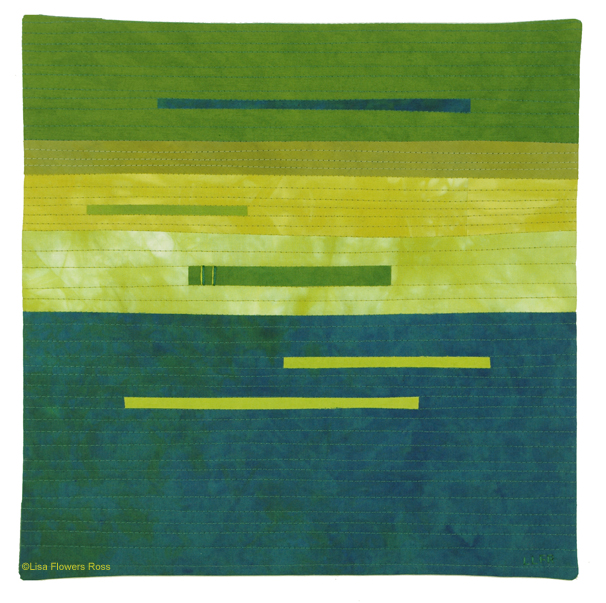
Striae I

Here is a better look at Striae I that is hanging in the WaterCooler building.  The Striae pieces are a subset of my Lines series. The light color section has lines that were screen printed as well as free-motion machine stitching lines.  The rectangle was created when the screens overlapped, same with the darker lines.


Striae I
hand dyed and screen printed fabrics,
machine pieced, free-motion machine stitching
16-1/2" x 18-1/2"
©2013 Lisa Flowers Ross
$250

Thursday, May 9, 2013

Art at the Watercooler

Several weeks ago I talked about the Chair Affair lecture event my friend and I went to.  The event was held at a building called the WaterCooler.  Here is a description of it:

"Located at the corner of 14th and Idaho, the WaterCooler is downtown Boise's home to emerging and innovative businesses - the future of job growth and economic potential in our community. We provide our residents with a home that encourages collaboration and offers mentoring, community engagement, growth, and success. We offer a venue for dialogue, learning, creativity, and the entrepreneurial spirit. A community-based non-profit, we welcome involvement and support."


Those are a bunch of water containers on the wall behind the desk.

While at the event, we noticed some local artists were showing artwork on some of the walls. Later, I contacted the building manager and ask if they would like some more artwork on their walls. The answer was yes.  

I went back to look at the walls and measure.  The other artists had the main walls in the front, but there were quite a few empty walls in the rest of the space.  Eventually, I decided to hang three pieces.


My Personal Logograph #5 hangs in this area that has a foosball table in it.  I think it helps brighten up the space.  I had originally planned to hang Sun Spots here, but that will be sent off to an exhibition soon.

The only lighting in the hallway areas seems to be natural lighting from the windows.  So it is a little dark.  These are the other two pieces I hung.  The one on the left is Striae I and one the right is Color Fields #15, in it's original orientation.  For my Color Fields exhibition, we decided to hang it vertically.


Tuesday, May 7, 2013

Three Color Reduction Monotype - Last Day

Monday was the last day of our Wingtip Press workshop with Rose Davies.  Rose will be giving a talk this Wednesday evening at Wingtip Press, 6:30 p.m., if anyone would like to attend.

The first few days of the workshop, my subject matter was representational images.  Amy asked me why I didn't do something like the more abstract stuff I do with fabric.  I had been thinking about that, noticing that when I am doing some kind of print, I mostly pick more realistic things. Why is that?

My thoughts are that the two mediums are so very different. So, my brain thinks about them differently. With the fabric, I can get a strong graphic line with a seam and have geometric shapes of color.  A linocut has a nice strong graphic line, but with this technique of monotype, you really have to work at getting a strong crisp line.  It lends itself better to more blending and softer lines.

However, Cassandra worked abstractly the first few days and inspired me to try something abstract on this last day.  (She did something representational on the last day.)  Below is one of her abstract prints.


I also did two prints instead of one.  Here is the yellow layer of one of them (it's upside down) and the other one was just all yellow.


Here is the first one with the red layer on top.  We used a little bit different ink this time and I think we were able to get more color on the first print.


Here is my second print with the red layer completed.

Then, we had a little tea break.  
Rose had made some Welsh cakes in the morning and brought them for us to try.  Very delicious.   

Afterward, it was back to work finishing up the blue layer.  Here is my second print completed.


Here is Cassandra's finished representational print.

I forgot to get a picture of my completed first print, but you can see it (along with the ghost prints) on the near end of the table in this picture where we have laid out most of the prints from the workshop.


When we had these laid out on the table, I noticed that my prints from the first two days had a similar palette of mostly greens and blues.  Whereas, the last day when I went abstract with the prints, the palette is mostly yellow and red (and very bright).  I think I would like to mess around with the stripes some more and the other abstract idea as well.

I'm really glad we had several days to work with this process.  As with most things, it helps to practice and it helped cement the concept into the brain.  I hope to do some more of this.

Sunday, May 5, 2013

Reduction Monotype Day 2

Saturday, we spent another day at Wingtip Press working on a second reduction monotype.  This time I chose a simpler subject, canning jars, but it was harder to work with.  I learned some things from the day before and hoped it would make today's print better.

Tyler and Rose working, with the press we used in the foreground.

Once again, we started with yellow.

Then comes process red.  This is my plate lying on top of the paper that was already printed with yellow.  It's ready to run through the press.

Here is Gale's print with the red printed.

Blue is last and you never know how it's going to turn out.  This is my final print.

After running the first print and the ghost prints with the blue, I decided to just run the blue plate through the press on a new sheet of paper.  I really like this ghost.

Here's Gale's final print.

And Carl's final print with the ghost print.

As I was working the different layers on mine, I realized, too late, I had made some mistakes.  I am not going to point them out to you.  But it is just more learning for me.  I am happier with my second print.

And here is some used up scrim that I thought looked pretty just lying on the table.


Saturday, May 4, 2013

Reduction Monotype

Yesterday was the second day of our workshop.  We worked on a three color reduction monotype.  Using a light box, we put our drawings or photos under a piece of plexiglass for reference.

First, you start by covering the plate with a layer of yellow ink (we used a litho process yellow mix with plate oil).  Then you start removing the ink with items like q-tips, scrim, brushes, chopsticks, etc.  Here is Rose demonstrating with her drawing.


Since we only used yellow, process red (magenta) and process blue, you really have to think about the areas where the colors will be mixed.  Not only do you remove all the white areas from the yellow but also any area you want pure blue, pure red, or purple.

When it's completed it looks something like this.


Then you put it on a piece of paper and run it through the press.   Since this is a monotype you will only get one print.  But a ghost image can be run through the press with a second piece of paper.

The plate gets cleaned off and you start the process again with red.  Below is my plate in the process of removing the areas where I don't want red (magenta).  I didn't want a lot of red so I ended up cleaning most of it off.  Where you leave all three colors you will get a black.


The red is printed on top of the same paper with the yellow.  So you have to be careful to register the plate very well for the second and third run through the press.  Here is my red printed over the yellow.


The last step is the blue and you really don't know what the print is going to look like until this very last step of running the blue through the press.

Here is my final print.  I'm not that happy with it as it turned how quite a bit different than what I had envisioned.  But now that I have been through the process I have a better idea of how the layers work together and the different ways to remove the ink.  

Here is the ghost print.  I could use this as a base to go back in and use colored pencils or pastels.


It is also good to see what others used and how they did theirs.  We all had fun watching each other pull their prints and watch how the different steps built up.  It was always a surprise at the end.

Here is Cassandra's finished print, which I love and is totally in her style.


Here is Tyler's finished print.

And here is the instructor's finished print.


I'm glad we get to do another one today and on Monday.  I think I need some more practice.